- Ulubatlı Hasan (sometimes written as Uluabatlı Hasan, in English Hasan of Uluabat) (1428 – May 29, 1453) was a Timarli Sipâhî in the service of Sultan Mehmed II of the Ottoman Empire who achieved legendary status as a heroic Turkish martyr at the successful Siege of Constantinople.[1]
- He was born in a small village called Ulubat (near Karacabey) in the province of Bursa ("Ulubatlı Hasan" meaning "Hasan of Ulubat" in Turkish). He must have been a very tall man, as Scottish historian Lord Kinross in his work The Ottoman Centuries reports that he was a "giant."
- At the age of 25 he was present at the Siege of Constantinople (April 6, 1453 – May 29, 1453). The Turks had tried to take the grand city and last stronghold of the Byzantine Empire several times before, but this time, under the command of Sultan Mehmed II, who was in his early twenties at the time and already showing potential of being a great military leader, it looked like victory was at hand. But despite several assaults and the severe hammering by the cannons the great double walls of Constantinople held for 53 days.
- On the early morning of the last day of the siege, May 29, after the morning prayers, the Ottoman military band started to play one of their songs and the city was stormed. Ulubatlı Hasan was among the first to climb the walls of Constantinople followed closely by thirty of his friends. He carried only a scimitar, a small shield and the Ottoman Flag.He climbed the wall, under showers of arrows, stones, spears and bullets. He reached the top and he placed the flag, which he defended until his 12 remaining friends arrived. After that he collapsed with 27 arrows still in his body. Seeing the Ottoman flag inspired the Ottoman troops and kept their spirits up until they had conquered Constantinople.
Memaparkan catatan dengan label Khilafah Islamiah. Papar semua catatan
Memaparkan catatan dengan label Khilafah Islamiah. Papar semua catatan
Jumaat, 26 April 2013
Do you know Hasan of Uluabat? the legendary martyr during the Conquest of Constantinople

Khamis, 25 April 2013
Do you know Admiral Sulaiman? the admiral of the Turkish fleet during the conquest of Istanbul
Baltoghlu Suleiman was an Ottoman admiral in the 15th century. He led the Turkish fleet against the Byzantines in 1453 during the final siege of Constantinople. Famous for the naval battle in which four Christian ships took on his entire fleet and managed to win and escape. Sultan Mehmed II
was so angered during the defeat that he rode his horse into the sea
screaming at Baltoghlu. Then, Hamza Bey replaced him. When the battle ended, Baltoghlu was brought in
front of Mehmed who promptly ordered that he be executed. Only after the
pleading of his subordinates who told of Baltoghlu's great bravery
during the battle in which he had even been wounded in the eye did
Mehmed spare his life. However, he was stripped of titles, land, and
wealth. He died in obscurity and poverty.[1] Some even believe that he became a simple sailor in the fleet.
Ahad, 21 April 2013
MISTERI PETA KUNO AMERIKA

Pada tahun 1929, sekumpulan pengkaji sejarah telah membuat penyelidikan di istana Topkapi yang terletak di Konstantinopel, Turki. Di dalam istana itu, mereka telah menemui segulung peta yang berusia ratusan tahun, yang diperbuat dari kulit rusa berukuran 90 x 65 cm. Peta tersebut bertarikh Muharam 919 bersamaan 9 Mac-7 April 1513.
Di atas peta itu, mereka telah menemui beberapa perkara yang aneh dan menakjubkan. Peta tersebut memaparkan outline pantai Amerika Utara dan Selatan dengan pengukuran yang amat tepat. Peta itu juga memuatkan maklumat yang sangat terperinci mengenai Amerika, Lautan Atlantik, Eropah dan pantai-pantai Afrika yang belum dijelajah oleh penjelajah Eropah pada masanya! Satu lagi perkara yang menghairankan para pengkaji tersebut, ia juga memaparkan benua Antartika, padahal wilayah itu belum pernah ditemui sehingga tahun 1818.
Kemudian mereka terus membuat kajian mendalam lagi, mereka membuat perbandingan antara jarak pantai timur Amerika dengan pantai barat Afrika pada peta kuno itu dengan jarak yang sama pada peta yang termoden sekali. Sekali lagi mereka tercengang kerana ia adalah sangat tepat dan ini mustahil dibuat oleh pelaut zaman itu kerana kelengkapan dan teknologi mereka umumnya diketahui sangat terhad untuk membuat kerja-kerja kartografi dan pemetaan. Adakah ini mencukupi untuk mengatakan peta kuno ini benar-benar menakjubkan? Tidak. Sebenarnya ada lagi perkara lain yang begitu aneh dan tersangat luar biasa. Tersangat luar biasa bagi sebuah peta kuno yang diperbuat daripada kulit rusa.
Peta aneh tersebut dipersembahkan kepada Arlington T. Mallerey iaitu seorang pakar peta kuno. Setelah beberapa lama membuat kajian, beliau akhirnya merasa bingung dengan peta aneh tersebut. Mengapa? Ini adalah kerana data geografi pada peta tersebut tidak berada dalam posisi yang tepat.
Orang-orang disekelilingnya mula ‘lega’ kerana akhirnya peta tersebut mempunyai kelemahannya. Kononnya sudah pasti ada kelemahan kerana peta itu dibuat oleh pelaut-pelaut kuno yang dikatakan hanya mengenali kompas dan bintang-bintang! Jadi apa nak dihairankan, walaupun mereka sedar persoalan bagaimana peta tersebut boleh memaparkan Antartika masih menjadi misteri. Tetapi Mallerey masih sangsi dengan peta itu. Beliau merasakan ada yang tidak kena dengan peta itu. Seakan-akan ada sesuatu yang lebih luar biasa yang ingin diberitahukan oleh helaian kulit rusa yang berbau hamis itu.
Akhirnya dengan bantuan US Navy Hydrographic Bureau, Mallerey membuat sebuah grid dan memindahkan peta itu ke dalam sebuah glob. Betapa terkejutnya Mallerey kerana peta tersebut didapati ternyata sangat TEPAT.
Kajian demi kajian terus dilakukan ke atas peta yang menghairankan ramai cendekiawan itu.
Kajian lanjutan dilakukan oleh Professor Charles H Hapgood dan Richard W Strachan. Mereka telah mengkaji peta ini berkali-kali dan akhirnya menjumpai satu aspek yang tidak diketahui para pengkaji sebelum mereka. Suatu perkara yang benar-benar mustahil dan luar biasa. Mereka menemukan bahawa peta kuno itu berkemungkinan merupakan gambar aerial yang difotokan dari suatu ketinggian tertentu. Sungai, lembah, pegunungan, pulau dan padang pasir, digambarkan dengan ketepatan fotografi yang amat tinggi. Dan tahap fotografi yang tinggi ini hanya dapat dicapai dengan menggunakan satelit .

Siapakah yang membuat peta yang menakjubkan itu? Bagaimana beliau dapat membuat peta yang begitu tepat dan canggih, yang pada masa kini hanya dapat dilakukan dengan menggunakan satelit? Adakah beliau berasal dari puak Viking, yang terkenal sebagai pelaut yang handal? Atau setidak-tidaknya penjelajah Sepanyol atau Portugis yang mendabik dada kononnya merekalah orang pertama yang mengelilingi dunia? (walaupun sebenarnya Ferdinand Magellan tidak pernah menghabiskan pelayarannya kerana terbunuh di Filipina, tetapi dihabiskan oleh Henry The Black atau Enrique dalam dialek Sepanyol yang nama sebenarnya Hitam berasal dari kepulauan Melayu dan sememangnya orang Melayu!)
Tidak, si pembuat peta ini bukanlah dari kalangan orang Eropah yang kononnya amat pandai dari semua bidang.
Peta itu adalah karya Muhiddin Piri Reis. Beliau ialah seorang pelaut, laksamana angkatan tentera laut Turki dan kartografer Muslim terkemuka dari abad ke-16!
SUMBER: myberita.com
Isnin, 8 April 2013
Do you know Urban, the supergun master to al-Fatih?
- Orban, also known as Urban (died 1453), was an iron founder and engineer from Brassó, Kingdom of Hungary (today Braşov, Romania) who cast superguns for the Ottoman siege of Constantinople in 1453.
- Orban was Hungarian according to the majority of sources, while some scholars also mention his potential German[6] ancestry. Alternative theories suggest his Wallachian roots and he was described by Laonikos Chalkokondyles with the unclear term "Dacian".
- In 1452 he originally offered his services to the Byzantines, but emperor Constantine XI could not afford his high salary nor did he possess the materials necessary for constructing such a large siege cannon. Orban then left Constantinople and approached the Ottoman sultan Mehmed II who was in preparations to siege the city, claiming that his weapon could blast 'the walls of Babylon itself'. Given abundant funds and materials, the engineer built the gun within three months at Adrianople, from which it was dragged by sixty oxen to Constantinople. In the meantime, Orban also produced other cannon instrumental for the Turkish siege forces.[11]
- The bombard technology which mostly German technicians[12] drew at first for the Hungarian Army had been established between 1400 and 1450 all over the Western Europe, transforming the siege warfare, with some pieces like the Faule Mette, Dulle Griet, Mons Meg and the Pumhart von Steyr still extant from the period. Urban, along with an entire crew, likely was killed during the siege when one of his superguns exploded, then not an unusual occurrence. A modern author speculated that "he could have been German too" based on other gun founders serving in the Royal Hungarian Court.
Ahad, 7 April 2013
Do you know Halil Pasha?
- Çandarlı (Chandarly) Halil Pasha was a highly influential Ottoman grand vizier under the Sultans Murat II and, for the first years of his reign, under Mehmet II (from 1439 to 1 June 1453 precisely).[1] He was a member of the Çandarlı Family, considered to have contributed nearly as much as the ruling Ottoman dynasty to laying the foundations of the Ottoman Empire. He is not to be confused with his grandfather who was a namesake (Çandarlı Kara Halil Hayreddin Pasha) and who had served under Murat I.
- Twice during the reign of Murat II, the sovereign, a religious and artistic mind not very keen on holding power himself, retired to the city of Manisa and Çandarlı Halil Pasha held the effective helm in the capital Edirne with Mehmet II, then still a child, as the nominal sultan. On both occasions, upon the dangers presented by allied European armies attacking Ottoman territories, Çandarlı called back Murat II and deposed Mehmet II to replace him with his father. These two incidents led to lasting resentment by Mehmet II towards Çandarlı. The Çandarlı family having become extremely rich, possibly richer than the Ottomans, did not help ease the tension either.
- When Mehmed II became sultan the Byzantine emperor Constantine IX send a messenger to the Ottomans asking for an increase of the annuity of Orhan or otherwise to release him.[2]Orhan was an distant Ottoman family member and could claim himself as pretender for the throne and start a civil war.[3] This method was used by the Byzantines several times before.[4] Halil pasha was appalled by the ineptitude of Constantine's threats and suggestions.
- In 1453, one of the first acts committed by the (then fully reigning) Mehmet II immediately after the conquest of Constantinople was to execute Çandarlı Halil Pasha and confiscate his property. It is interesting to note that the city had been taken on 29 May 1453 and this execution took place on 1 June 1453, suggesting a design conceived by the sultan for a long time.
- Mehmet II has thus ended the period called Çandarlı era in the Ottoman Empire, and the later members of family, whose descendants came to our day, became no more than provincial notables based in İznik, although they were to give yet another, short-term, grand vizier to the Ottoman Empire at the end of the 15th century (Halil's son Çandarlı Ibrahim Pasha).
- Çandarlı Halil Pasha was, as such, the first Ottoman grand vizier to be executed.
Jumaat, 29 Mac 2013
The Great Conquest of Constantinople
Constantinople
- Ever since Constantine the Great moved his capital from Rome to the old Greek city of Byzantium and named it after himself, Constantinople had been coveted by enemies. Russians and Arabs, Magyars and Bulgars, Vikings and Seljuk Turks had all besieged it. It had resisted them all.
- On the north of the city a wall studded with towers ran along the shore of the Golden Horn , then around the point and down along the Sea of Marmara, south of the town .
- To the west of the city, on dry land, were Constantinople's famous double walls.
- Actually, there were three walls, because the inner face of the water ditch in front of the walls—a moat 60 feet wide and 15 feet deep—was built high enough above the surface of the ground to act as a breastwork . Behind the moat was a 25-foot wall with towers less than a bowshot apart . Twenty yards behind that wall was a 45-foot wall with 112 towers, each 60 feet high .
- The native Greeks (Greek Orthodox) hated the "Latins " (Roman Catholics) . The Latins returned the feeling. The town of Galata, across the Golden Horn , had been settled by Genoese, who declared their neutrality in the coming battle with the Turks .
- To gain help from the West, Emperor John VI , the predecessor of Constantine XI, agreed to accept the leadership of the Pope . This outraged his own people .
- When Constantine accepted Latin help, an Orthodox priest named Gennadius roused a mob , which rioted outside the Emperor's palace shouting "Death to the excommunicated! " (the Latins).
- Of 25,000 men of military age in the city, Constantine could find only 5,000 willing to fight the Turks . The Pope sent 20 0 men under a Cardinal Isidore, and a number of Latin (mostly Italian) volunteers and mercenaries joined the defenders.
- In response, the Orthodox priests announced that they would refuse absolution to anyone who had any dealings with the Latins . Altogether, Constantine could oppose Mohammed's 200,000 men with about 8,000 .
- Mohammed's army, however, looked more formidable than it was. Of the 200,000, according to a Florentine soldier named Tedaldi, only 140,000 were effective soldiers. The rest were "thieves, plunderers, hawkers, and others following the army for gain and booty. "
- But 12,000 of the soldiers were Janissaries, the best infantry of any European nation .The rest were Bashi-bazouks, Turkish feudal cavalry, and peasant militia from Anatolia.
- The most impressive part of the Turkish army was its artillery. Mohammed had more guns and bigger guns than any prince in Europe or Asia. He has been called
"the world's first great artilleryman. " - If cannons were Mohammed' s greatest asset, Constantine's greatest asset was two men, both foreigners and Latins : Giovanni Giustiani of Genoa, a famous commander who arrived with 700 soldiers in two large galleys, and Johann Grant, a German military engineer. Constantine appointed Giustiani commander-in-chief of his forces.
- Mohammed took a few Byzantine outposts , in one case, driving out the garrison with a gas attack, using burning sulfur. He then impaled the garrisons. Next, he
brought up his heavy guns . The guns moved at a snail's pace . To drag one of these guns took 50 yoke of oxen and 45 0 men . It took about two hours to load each gun ,
and the guns could fire only seven or eight shots a day. - Constantine and Giustiani had plenty of warning about where the attack would take place. That was a good thing , because Constantine had only one man for each 18-foot section of wall if he spread them evenly. As it was, in the sections of the wall not directly threatened , Giustiani reduced the defenders of the towers to squads of three or four men .
The assault
On April 12 , Mohammed began the world's first organized artillery bombard-
ment . There were a dozen great bombards , enormous cannons that fired stone balls
weighing more than 1,400 pound s and 56 smaller guns . Firing went on night and
day, but at first without noticeable effect. Then the Turkish gunners concentrated on
a single spot on the wall. Eventually, the outer wall crumbled , but the Turks found
that their enemies had built a new wall behind it.
On April 18 , the impatient Mohammed ordered a general attack. Giustiani had
no artillery like Mohammed's , but he defended the wall with small cannons, catapults,
muskets, crossbows, and "wall guns, " small, portable cannons that fired five lead balls
with each shot . He mowed the Turks down in heaps . Mohammed was so enraged by
the failure of his infantry, he thought about loading their bodies into the bombards
and shooting them over the walls of Constantinople .
At the same time the Turkish fleet tried to break the chain across the Golden
Horn , as the Venetians had done three centuries before. But the chain remained
unbroken . The Turkish navy was not the Venetian navy. It proved that two days
later.
Three Genoese warships loaded with soldiers and munitions approached the
harbor, escorting an East Roman grain ship. The Turkish admiral, a renegade Bul-
garian named Baltoglu, led 145 Turkish galleys out to capture the Christian ships.
The Genoese smashed through the Turkish fleet, ramming some galleys and snap-
ping banks of oars off others . The Constantinople garrison lowered the chain to let
the Christian ships in, then raised it again. Mohammed again flew into a rage and ordered Baltoglu to be impaled. His officers, fearing the precedent that executing a
commanding officer would set, talked him out of that . So Mohammed had four slaves
spread-eagle Baltoglu on the ground while he beat the unfortunate admiral with a
heavy stick.
The sultan sent an envoy to the Emperor with a proposal : that Constantine move
to the Pelopennesus in Greece and rule from there but let Mohammed have the city.
Constantine refused.
Because he could not break the chain across the Golden Horn , Mohammed
decided to go around it. He sent workers to level the mile of dry land between the
Bosphorus and a stream called The Springs. They built a wooden runway, greased it,
and dragged 70 ships over it . Next, he built a floating bridge over the Golden Horn .
Now he could concentrate his forces anywhere he wanted .
On May 7, Mohammed launched another assault on the walls. Giustiani and his
men beat it back with heavy losses. Mohammed tried again May 12 and suffered even
heavier losses. The sultan, however, was constantly getting reinforcements . The East
Romans were not .
The Turks on May 18 rolled a siege tower up to the moat . Gunners on its top
could shoot down on the walls to clear them of defenders. As the attackers attempted
to get the tower across the moat , Giustiani rolled barrels of gunpowder into the ditch
and blew it up .
"What I would not give to win that man over to my side, " Mohammed said. He
attempted to bribe the Genoese, but Giustiani would not be tempted .
Above-ground assaults having failed, Mohammed tried mining . Johann Grant
half-buried drums behind the walls. The vibrations of the drums showed him where
the enemy was digging . Then he dug counter mines . He blew up some Turkish tun-
nels and filled others with poisonous sulfur dioxide from fire pots . He flooded other
tunnels or sent infantry through his countermines to kill the Turkish diggers .
Mohammed was growing worried . He feared that if he didn't take Constanti-
nople soon, the Christian nations would unite and send relief. He ordered an assault
on all of the walls to begin May 29 . It would continue night and day until the city
was taken . The defenders had to extend themselves to the breaking point , but they
continued to beat off the waves of Turkish attackers.
At the north end of the land walls, where they joined the wall along the Golden
Horn , the Turks got a break. From ancient times there had been a tiny postern gate
in the ditch . Emperor Isaac Angelus had blocked it up during the crusader troubles in
1204, but it had recently been reopened—and forgotten . Some Janissaries found the
undefended gate and rushed in. Their greed almost destroyed this golden opportu-
nity. They were plundering the palaces when defenders led by the Bocchiardi broth-
ers, who were Latin volunteers, closed the postern passage and cut off their retreat .
Driven out of the palace, the Turks ran south , inside the inner wall.
Meanwhile, Giustiani was fatally wounded , causing some confusion among his
troops . Then , the Turkish fugitives hit them in the flank . The main Turkish army got
over the wall, Constantine led a countercharge and was killed, and Constantinople
became a Turkish city.
There was a massacre, of course, but Mohammed stopped it. He had no wish
to rule a desert . He gave the Christians in the city freedom to worship in their own
way and appointed the Latin-hating Gennadius patriarch . Constantinople has been a
Turkish city ever since.
Khamis, 28 Mac 2013
KENALI RUMELI HISARI
 |
| Rumeli Hisari dari Selat Bosforus |
A. INTRODUCTION
- Rumelihisarı (Rumelian Castle) is a fortress located in the Sarıyer district of Istanbul, Turkey, on a hill at the European side of the Bosphorus. It gives the name of the quarter around it. It was built by the Ottoman Sultan Mehmed II between 1451 and 1452, before he conquered Constantinople. The three great towers were named after three of Mehmed II's viziers, Sadrazam Çandarlı Halil Pasha, who built the big tower next to the gate, Zağanos Pasha, who built the south tower, and Sarıca Pasha, who built the north tower.
 |
| Rumeli Hisari dari Bosforus |
B. CONSTRUCTION
- Rumelihisarı is situated at the narrowest point with 660 meters of the Bosphorus strait, just opposite of Anadoluhisarı (Anatolian Castle) on the Anatolian side, which is another Ottoman fortress that was built between 1393 and 1394 by Sultan Bayezid I.
- Rumelihisarı was built by Sultan Mehmed II between 1451 and 1452 in order to control the sea traffic on the Bosphorus strait and prevent aid from the Black Sea to reach Constantinople during the Turkish siege of the city in 1453, particularly from the Genoese colonies such as Caffa, Sinop and Amasra.
- In a previous Ottoman attempt to conquer the city, Sultan Murad II (1404–1451) had encountered difficulties due to a blockade of the Bosphorus by the Byzantine fleet. The necessity of a fortress opposite of Anadoluhisarı was thus well known to the Ottomans.
- On the location of Rumelihisarı, there had been a Roman fortification in the past, which was used as a prison by the Byzantines and Genoese. Later on, a monastery was built there.
- In preparation for the conquest of Constantinople, Sultan Mehmed II (1432–1481), son of Murad II, started to realize the construction of the fortress immediately following his second ascent to the throne in 1451. He refused the plea for peace of the Byzantine Emperor Constantine XI (1404–1453), who understood the intention of the Sultan.
- The construction began on 15 April 1452. Each one of the three main towers was named after the Pashas who supervised their construction. The Sultan personally inspected the activities on the site. With the help of thousands of masons and workers, the fortress was completed in a record time of 4 months and 16 days on 31 August 1452.
- The sultan wanted to cheer up the builders so he allegedly ordered them to build the castle in the shape of the name of Muhammad the Muslim prophet, which can be seen from above. Muhammad and Mehmed share the same Arabic spelling (محمد), and so he may have also made the fortress as an homage to himself.
 |
| Peta Rumeli Hisari |
C.ARCHITECTURE
- The Rumelihisarı fortification has one small tower, three main towers, and thirteen small watchtowers placed on the walls connecting the main towers. One watchtower is in the form of a quadrangular prism, six watchtowers are shaped as prisms with multiple corners and six others are cylindrical.
- The main tower in the north, the Saruca Pasha Tower, is in cylindrical form with its 9 stories and height of 28 m (92 ft), has a diameter of 23.30 m (76.4 ft) and its walls are 7 m (23 ft) thick. Today, this tower is called the Fatih (Conqueror) Tower after Sultan Mehmed II.
- Halil Pasha Tower, a dodecagon prism, which stands at the waterfront in the middle of the fortress, has also 9 stories. It is 22 m (72 ft) high with a 23.30 m (76.4 ft) diameter and the walls are 6.50 m (21.3 ft) thick.
- The main tower in the south, the Zağanos Pasha Tower, has only 8 stories. The cylindrical tower is 21 m (69 ft) high, has a 26.70 m (87.6 ft) diameter with 5.70 m (18.7 ft) thick walls.
- The space within each tower was divided up with wooden floors, each equipped with a furnace. Conical wooden roofs covered with lead crowned the towers. The outer curtain walls of the fortress are from north to south 250 m (820 ft) long and from east to west varying between 50 and 125 m (164 and 410 ft) long. Its total area is 31,250 m2 (336,372 sq ft).
- The fortress had three main gates next to the main towers, one side gate and two secret gates for the arsenal and food cellars next to the southern tower.
- There were wooden houses for the soldiers and a small mosque, endowed by the Sultan at the time of construction. Only the minaret shaft remains of the original mosque, while the small masjid added in the mid-16th century has not survived.
- Water was supplied to the fortress from a large cistern underneath the mosque and distributed through three wall-fountains, of which only one has remained. Two inscriptive plaques are found attached on the walls.
- The fortress, designed by architect Müslihiddin, was initially called "Boğazkesen", literally meaning "The Strait Cutter", referring to the Bosporus Strait. The name carries a secondary and more macabre meaning; as boğaz not only means strait but also "throat" in Turkish.
- It was later renamed as Rumelihisarı, which means "Fortress on the Land of the Romans", i.e. Byzantine Europe, or the Balkan peninsula.
 |
| Pemandangan dari Rumeli Hisari |
D. USAGES
- A battalion of 400 Janissaries were stationed in the fortress, and large cannons were placed in the Halil Pasha Tower, the main tower on the waterfront. A Venetian ship coming from the Black Sea which ignored the order to halt by the commander of the fortress, Firuz Ağa, was bombarded and sunk, and its surviving crewmen were impaled as a warning to any who might attempt the same.
- These cannons were later used until the second half of the 19th century to greet the sultan when he passed by sea.
- After the fall of Constantinople, the fortress served as a customs checkpoint. Rumelihisarı, which was designated to control the passage of ships through the strait, eventually lost its strategic importance when a second pair of fortresses was built further up the Bosphorus, where the strait meets the Black Sea.
- In the 17th century, it was used as a prison, primarily for foreign prisoners of war. Rumelihisarı was partly destroyed by an earthquake in 1509, but was repaired soon after.
- In 1746, a fire destroyed all the wooden parts in two of the main towers. The fortress was repaired by Sultan Selim III (1761–1807). However, a new residential neighborhood was formed inside the fortress after it was abandoned in the 19th century.
Pembukaan Istanbul (Pembukaan Agung)

- Kota Constantinople pada era Byzantine
 Peta wilayah timur Mediterranean pada 1450Peta wilayah timur Mediterranean pada 1450 (versi Arab)
 - Sultan Muhammad 2 telah membina sebuah kubu (dikenali sebagai "Rumeli Hisari") di Selat Bosforus untuk menghalang bekalan-bekalan sampai ke Konstantinapol dari kerajaan Trabzon.
-

Peta Rumeli Hisari
 Pemandangan Selat Bosforus dari Rumeli Hisari
 Pemandangan Rumeli Hisari dari Selat Bosforus
 Pemandangan Rumeli Hisari dari Selat Bosforus dari jarak dekat. Kelihatan Menara Halil Pasha
 Pemandangan bahagian Asia dari Turki dari Rumeli Hisari. Kelihatan Menara Halil Pasha dan Jambatan al-Fatih.
 - Apabila hal ini sampai kepada Maharaja Baizantin, Constantine XI(60) Palaiologos, dia telah menghantar utusan kepada baginda bagi mengajukan kesediaannya membayar jizyah kepada baginda dengan syarat baginda tidak membina kubu tersebut.
-
 Kepungan al-Fatih dan bala tenteranya terhadap kota Constantinople. Pasukan tentera infantri terdiri daripada pasukan utama yang dipimpin sendiri oleh al-Fatih dan pasukan kedua oleh Zaganos Pasha, manakala pasukan armada laut diketuai oleh Hamza Bey.
- Sultan Muhammad 2 telah mengepung bandar tersebut pada tahun 1453 dari arah daratan dengan kekuatan tentera mencecah 250,000 orang tentera manakala dari arah laut, satu armada kapal perang daripada 180 buah kapal.
- Baginda juga telah meletakkan sekitar bandar tersebut, 14 buah pencucuh artileri yang diletakkan padanya meriam gergasi sepanjang 80 hasta (36.576m) yang mampu melancarkan batu seberat sepuluh paun (25 kg) dengan jarak satu batu.
- Salah seorang ahli sejarah Rom Timur menyatakan bahawa berat batu 300 kg dan jarak tembakan lebih dari 1 batu dan menggerakkannya memerlukan 700 orang lelaki.
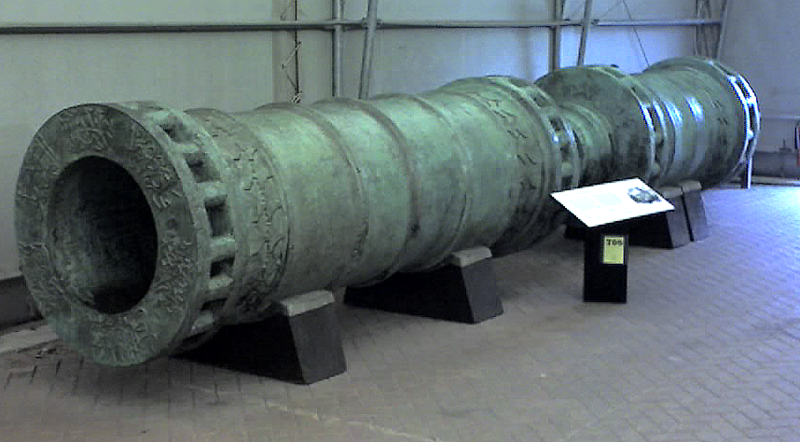
 Bola batu seberat 300 kgMeriam Dardanelles: adalah senjata pengepungan sejak sejurus selepas kejatuhan Constantinople pada 1453. Ia dicetak dalam gangsa dan telah dibuat dalam dua bahagian: laras yang memegang tembakan dan ruang yang memegang pembakaran. Dua bahagian skru bersama-sama dan terdapat cincin soket di hujung setiap bahagian, ini diambil tuil untuk memudahkan 2 bahagian ini dipasang dan dibuka. .
Panjang keseluruhan adalah 5.2 m dan ia berat 16,8 tan metrik. Ia menembak bola batu kira-kira 300 kg beberapa 1600 m. Kadar kebakaran adalah sangat perlahan - kira-kira 15 pusingan setiap hari. - Maharaja Constantine XI Palaiologos berasa terancam dan meminta bantuan daripada raja-raja Eropah. Mereka menghantar armada laut kepadanya bagi memecahkan kepungan dari kota Constantinople kerana mereka mengetahui bahawa kota itu mempunyai 3 lapis tembok yang tidak mungkin ditembusi kecuali daripada sebelah teluk di mana ia mempunyai hanya satu lapis tembok.
- Armada laut bantuan kepada Rom Timur dari Genoa, Itali di bawah Komander Justiniani yang datang dari arah laut dan cuba untuk memasuki pelabuhan Constantinople maka ia telah ditentang oleh kapal-kapal laut Usmaniyyah dan telah berlaku peperangan sengit antara mereka pada 11.4.857 hijrah bersamaan 21.4.1453.
- Ia berakhir dengan kemenangan Justiniani dan pasukannya memasuki kota selepas tentera Constantinople menaikkan rantai besi yang dipasang untuk menghalang kapal-kapal Usmaniyyah daripada sampai kepada mereka, kemudian rantai itu dikembalikan seperti asal selepas Justiniani dan pasukannya melepasinya.

- Selepas itu, Sultan memikirkan jalan memasukkan kapal-kapalnya ke pelabuhan Constantinople untuk menyempurnakan kepungan darat dan laut maka terlintas di fikirannya idea ganjil iaitu memindahkan kapal-kapal laut di atas daratan untuk melepasi rantai besi yang dipasang untuk menghalang mereka.
- Idea ganjil ini disempurnakan dengan membuka jalan di atas darat, yang telah berbeza pendapat tentang jaraknya dan pendapat yang kuat mengatakan jaraknya adalah 2 farsakh (6 batu) dan timbunan kayu dicurahkan minyak dan lemak supaya memudahkan gelongsor kapal-kapal di atasnya.

Gambaran pelukis bagaimana al-Fatih memantau usaha penarikan kapal-kapal perangnya- Dengan cara ini, dapatlah dipindahkan sebanyak 70 buah kapal pada satu malam sehingga ketika siang menjelma dan orang yang terkepung melihatnya, mereka berasa yakin tidak dapat dielakkan kemenangan tentera Usmaniyyah ke atas mereka tetapi ia tidak melemahkan semangat mereka bahkan telah menambah sifat agresif dan berazam untuk mempertahankan tanahair mereka hingga mati.
- Pada tanggal 15.5.857 Hijrah bersamaan 24 Mei 1453, Sultan Muhammad telah menghantar (wakil) kepada Maharaja Rom Constantine XI Palaiologos memberitahunya bahawasanya jika dia menyerahkan negara itu kepadanya secara sukarela, baginda berjanji kepadanya dengan tidak mengusik kebebasan ahlinya atau harta benda mereka dan akan memberinya Kepulauan Crete tetapi dia tidak menerima usul itu bahkan memilih kematian ke atas penyerahan kota.
- Ketika itu, Sultan memberi peringatan kepada tenteranya agar bersiap sedia untuk serangan besar-besaran pada 20 Jamadil Awwal 857 hijrah bersamaan 29 Mei 1453 dan baginda telah menjanjikan kepada tenteranya dengan ganjaran apabila kemenangan telah disempurnakan dan membahagikan mereka tanah yang banyak.
- Pada malam sebelum hari dijanjikan (serangan), tentera Usmaniyyah telah menyalakan lampu di depan khemah-khemah mereka untuk meraikan kemenangan yang pasti bagi mereka dan berterusan sepanjang malam mereka bertahlil dan bertakbir sehingga apabila menjelang fajar, telah dikeluarkan kepada mereka arahan menyerang.




 Pedang al-Fatih
 - Maka 150 ribu orang tentera telah menyerang dan memanjat tembok kota sehingga memasuki bandar dari segenap penjuru dan menghunus pedang pada sesiapa yang menentang mereka.

Tembok kota yang telah diperbaiki
- Mereka telah memasuki Gereja St. Sophia di mana Ketua Paderi sedang berdoa dan bersama-samanya sebilangan besar penduduk kota.

- Ketua Paderi keluar dari gereja dan dia menyempurnakan doanya yang terputus ketika tentera Usmaniyyah memasukinya ketika pembukaan. Telah mencatat sebahagian mereka kemenangan nyata ini (negara yang baik) pada tahun 857 Hijrah dan dinamakan bandar sebagai “Islambul” iaitu di bawah Islam atau bandar Islam.
- Adapun Maharaja Rom telah berperang sehingga terbunuh dalam mempertahankan tanahairnya dan selepas dibuka , ia dijadikan sebagai ibu negara dan akan kekal begitu.
- Perlu diperingatkan bahawa tentera Islam telah mengepung kota ini sebanyak 11 kali sebelum ini, 7 daripadanya ketika 2 kurun Islam yang pertama.
- Kemudian sempurna kemasukan Sultan ke dalam bandar pada waktu Zohor maka baginda dapati tentera sibuk dengan rampasan dan penggeledahan dan lain-lain maka baginda telah mengeluarkan perintah menghalang segala kekerasan, maka keamanan menguasai serta merta.
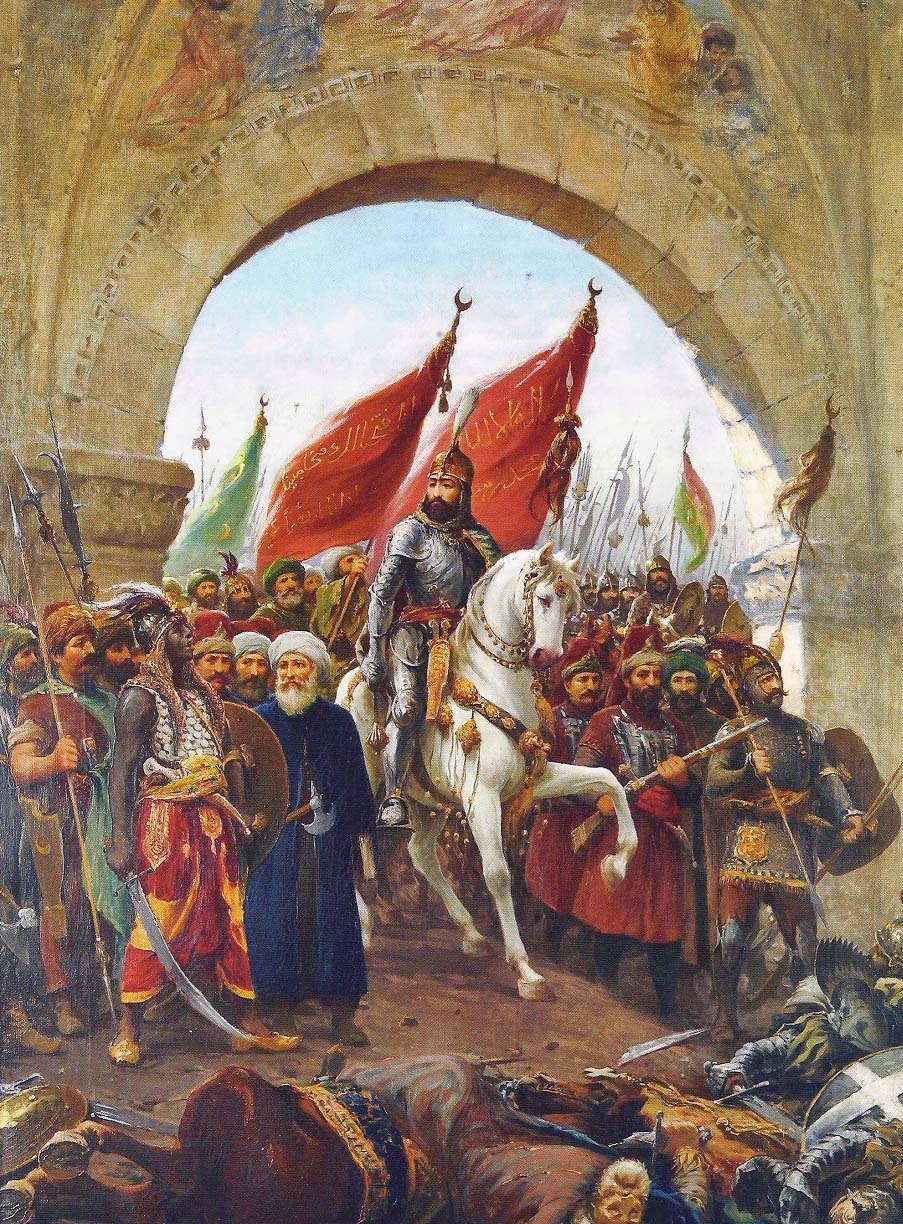
Gambaran pelukis suasana ketika al-Fatih memasuki kota Constantinople
- Kemudian baginda memenziarahi Gereja St. Sophia dan mengizinkan solat di dalamnya secara warta dengan menjadikannya sebagai masjid besar bagi umat Islam.
 Hadis Nabi saw yang memberitahu pembukaan kota Constantinople di pasang pada dinding Masjid Aya Sophia
- Maka selepas sempurna pembukaan, baginda telah mengumumkan pada segenap penjuru bahawasanya tidak dihalang mendirikan syiar agama Nasrani bahkan dijamin bagi mereka kebebasan beragama dan keselamatan harta mereka. Maka pulanglah sebahagian mereka yang telah berpindah dan memberikan mereka separuh ruang gereja dan menjadikan separuh lain sebagai masjid.
- Kemudian baginda mengumpulkan ketua-ketua agama nasrani untuk memilih ketua paderi. Maka mereka telah memilih George Scolaris.
- Sultan telah berpegang dengan keputusan pemilihan ini dan menjadikannya ketua bagi minoriti Rom dan meraikan perlantikannya dengan kemegahan dan peraturan yang sama sebagaimana yang diamalkan oleh paderi-paderi pada zaman Maharaja Rom Nasrani.
- Sultan telah memberinya pengawal dari Unit Janissari dan memberinya hak penghakiman dalam kes-kes sivil dan jenayah dengan semua jenisnya yang berkaitan dengan orang Rom dan telah dilantik juga bersamanya sebuah majlis yang terdiri daripada pegawai-pegawai utama gereja dan hak ini telah diberikan di wilayah kepada para paderi. Sebagai balasan pemberian ini, mereka perlu membayar kharaj terkecuali ketua-ketua agama sahaja.
- Semasa peperangan, para pejuang telah menemui kubur sahabat besar Abu Ayyub al-Ansari yang telah syahid pada 52 hijrah ketika mengepung Constantinople di zaman Khalifah Muawiyyah Abu Sufian r.a.
- Selepas pembukaan, Sultan telah membina sebuah masjid di sekitar kuburnya dan menjadikan tradisi Usmaniyyah bahawa semua sultan ketika perlantikannya membawa pedang “al-Ghazi” Usman 1 di masjid ini dan kekal tradisi ini sehingga berakhir Daulah Usmaniyyah.
Langgan:
Catatan (Atom)